
Office project for a European company operating in the Middle Eastern financial market
First impressions are formed instantly. For investors, this moment determines their trust in the company. As a European investment firm entered the Middle Eastern market, they approached us with a request to create a space that would communicate their values and professionalism in this new region.
The client aimed to establish an office that balances European restraint with the comfort expected in Middle Eastern business environments.
Status without excessive ostentation became the guiding principle of the concept.
Our task was to design a space that resonates equally well with representatives of different cultures while maintaining the company’s identity—without attempting to mimic local aesthetics.
Reception: Balancing Prestige and Hospitality
The reception area is the first point of contact with the company, so we gave it special attention.
We used light oak with a brass base, a combination that conveys reliability and professionalism. Vertical wooden panels on the walls add height and rhythm to the space.
Workspaces: Functionality as a Priority
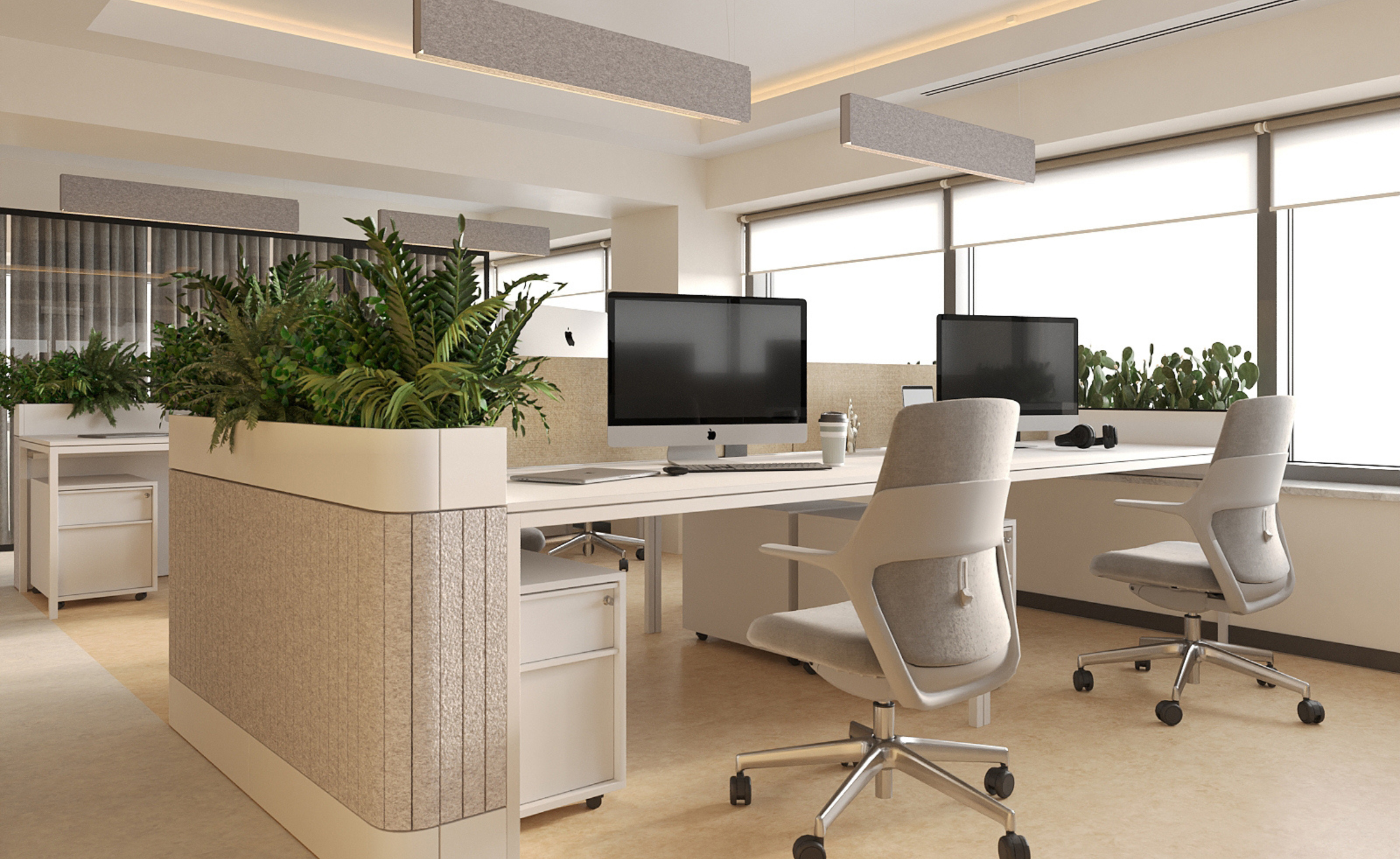
Workstations are organized into practical clusters, separated by modular partitions with integrated planters. These elements serve three purposes:
- Zoning the space
- Enhancing acoustics
- Creating a healthy microclimate
Lighting is designed to prevent glare on monitors and maintain an optimal brightness level throughout the day.
Meeting Rooms: Different Formats for Different Needs
Recognizing the importance of face-to-face meetings in the investment sector, we designed meeting spaces in various formats:
- Private meeting rooms for confidential discussions
- Larger conference rooms for investment presentations
Executive Office: Status Without Excess
In business, a leader’s status is significant, so the CEO’s office was designed with this in mind.
The centerpiece is a solid dark wood desk—the only deliberate contrast in the office’s neutral palette.
Veneered wood on the walls provides additional sound insulation for confidential conversations, while a dedicated area for informal meetings allows for private discussions with key partners, blending prestige with hospitality.
A Culturally Neutral Space as a Strategic Advantage
The key design decision was to create a culturally neutral space—a universal environment that neither imitates local aesthetics nor imposes European standards.
This universal design became a strategic advantage: rather than conforming to cultural stereotypes, it creates a space where diverse business communities can work comfortably.